AI Competence

AI Competence as ROI Driver

Why AI knowledge isn't a cost factor – but your strongest lever. BCG AI Radar 2026, EU AI Act, and the honest calculation.

Reading time: approx. 10 minutes | Article 4 of 4

AI competence as driver for productivity gains

Executive Summary

Half of CEOs surveyed by Boston Consulting Group believe their job depends on whether AI delivers results in 2026. Not in five years. This year.

The BCG AI Radar 2026 surveyed 2,360 executives from 16 countries. The message is clear: AI has migrated from the IT department to the CEO's desk. 72 percent of CEOs worldwide state they are the primary decision authority for AI in their company – twice as many as the previous year.

In Austria, the adoption curve is steep – and accelerating. According to Statistics Austria, by 2025 already 30 percent of companies with ten or more employees used at least one AI technology – compared to 20 percent in 2024 and 11 percent in 2023.

The European Investment Bank puts the figure higher: 45 percent of Austrian companies use AI in at least one business area, significantly above the EU average of 37 percent.

The tools are coming. The question is whether anyone actually knows how to use them.

Conviction Without Competence

AI agenda on the CEO's desk

AI has migrated from IT to the CEO's desk

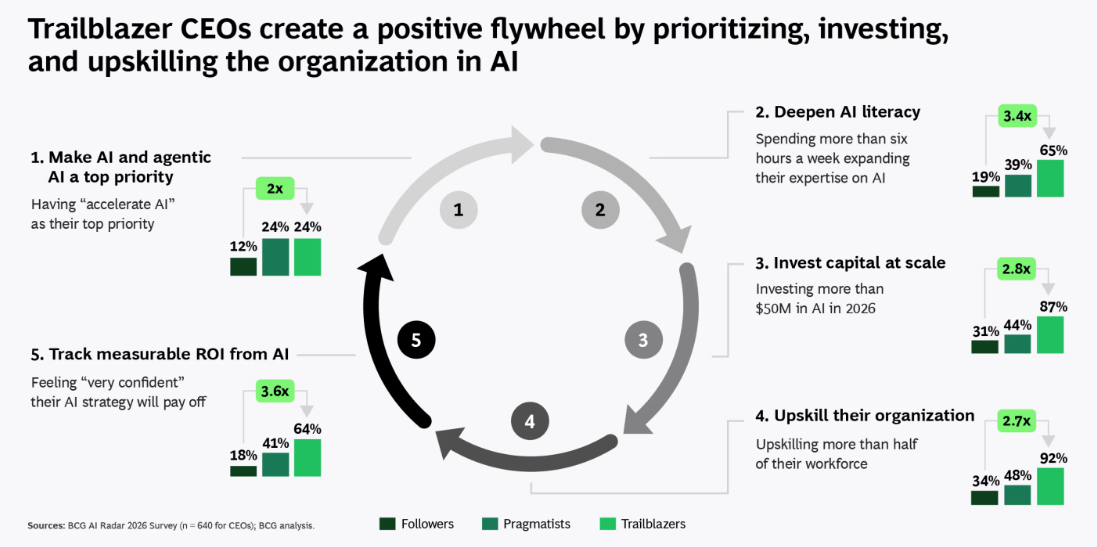
The BCG data reveals three CEO archetypes:

  • 15% Pioneers: Deeply convinced, heavily investing, personally engaged
  • 70% Pragmatists: Selectively investing, wait-and-see approach
  • 15% Laggards: Cautious first steps

The difference between these groups is not primarily a matter of money. It's a matter of knowledge.

The Numbers Speak for Themselves

  • Pioneers have upskilled 69 percent of their workforce
  • Pragmatists: 41 percent
  • Laggards: 35 percent

Pioneers spend more than 8 hours per week building their own AI expertise. Pragmatists manage 7, Laggards 5.

The CEO AI Flywheel

BCG calls the pioneers' pattern the "CEO AI Flywheel": Prioritize AI, deepen competence – starting with yourself – invest at scale, qualify the organization, measure ROI. Each step reinforces the next.

The flywheel only turns when it starts at the top. And it starts with learning, not buying.

What "AI Competence" Actually Means – And Why Tutorials Aren't Enough

When consultants talk about AI competence, they mean training programs and certificates. That's part of it, but it misses the core.

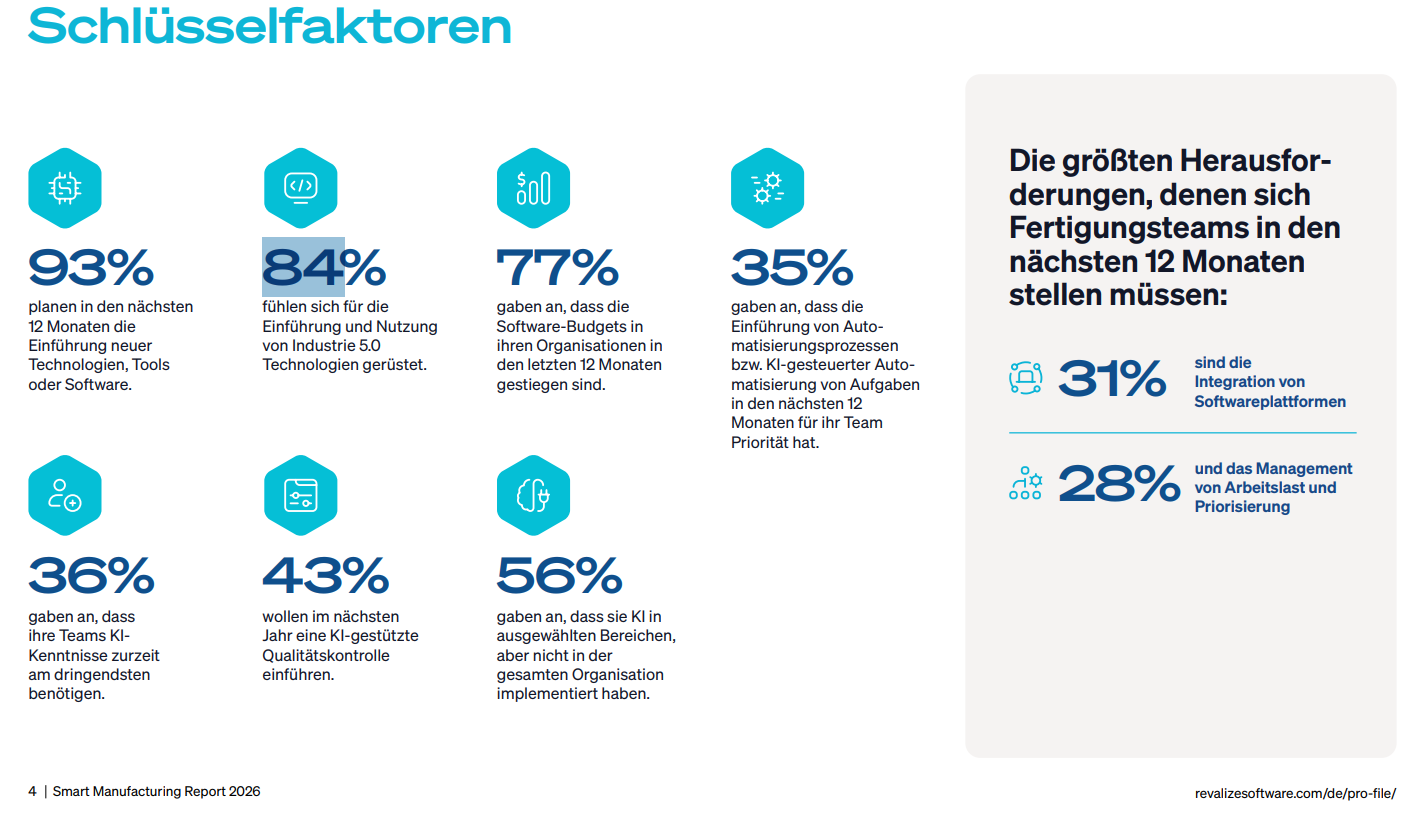
Revalize Study "Smart Manufacturing 2026"

500 executives in Germany, Austria, Switzerland, and the USA reveal the gap:

  • 84 percent of DACH manufacturers feel ready for Industry 5.0
  • 93 percent plan new technology rollouts
  • And yet: 56 percent use AI only in isolated areas

Holistic implementation remains the exception.

The cycle of AI adoption

The cycle of successful AI adoption

This aligns with the first three articles in this series:

  • Isolated tool adoption destroys AI ROI ("The Architect's Illusion")
  • AI must be understood as an operating system ("Strategic Process Intelligence")
  • Decision-makers must understand the mechanics ("AI Sovereignty")

The Sparring Analogy

AI competence can't be built through tutorials. You build it like a boxer builds skills – through sparring.

A boxer who only works the heavy bag learns technique. A boxer who faces a good opponent learns timing, adaptation, and what to do when things don't go according to plan. The heavy bag doesn't hit back. A sparring partner does.

You only learn what a model can really do for your business when someone challenges your assumptions, shows where your prompts fall short, and forces you to rethink your processes.

That's why "AI Literacy" as a checkbox exercise – half-day workshop, certificate, done – achieves so little. Real competence grows through repeated, challenging interaction.

Pioneers don't spend more per capita on tools. They spend smarter – because their people know what to do with the tools. That's the ROI driver. Not the software. Not the interface. The capability that makes both effective.

The Regulatory Deadline Sharpens the Point

AI competence has not been optional since February 2025. Article 4 of the EU AI Act requires every company deploying AI systems to ensure adequate AI competence of its personnel.

Enforcement begins August 2, 2026.

Challenges of AI adoption

Overview of AI adoption challenges

What This Means Concretely

For an SME in Austria, this means concretely: If your team uses ChatGPT, Copilot, or another AI tool in daily business – and at least 30 percent of Austrian companies do – you bear responsibility starting this summer that your people know what they're doing. Not abstractly. Concretely, with the tools they use daily.

The EU doesn't prescribe a format. What it demands is demonstrability: Technical understanding, legal awareness, practical experience. At stake are fines, business interruptions, and liability for damages from inadequate AI qualification.

Who Is Affected?

  • The real estate agent creating listings with AI
  • The construction contractor whose calculations are based on AI-supported estimates
  • The managing director whose team uses AI tools she herself knows nothing about – the Shadow AI problem that according to industry estimates affects nine out of ten companies

The Honest Calculation

Company A

Spends a six-figure sum – licenses, platform, integration, three-day workshop.

After a quarter, 4 out of 20 employees use the system regularly. The others tried it, got unusable results, and returned to their old processes.

The investment is on the books. The return is not.

Company B

Spends €30,000 on a sparring partner who works with the team for four months.

Not with slides, but with the real tasks the team works on daily. It takes longer, it's more uncomfortable – and it works.

In the end, 16 out of 20 use the tool. Not because they have to, but because they understood where it helps them.

The difference isn't the budget. The difference is whether someone challenged the team to push past the first disappointment – and kept pushing until the tools became part of the workflow.

Competence doesn't pay off on day one. But incompetence pays off immediately – in sunk costs, in lost time, in Shadow AI running uncontrolled through your processes, and in an organization starting over six months later when the next platform arrives.

What Comes Next

In four articles, we've laid the foundation:

  • Why isolated AI tools fail
  • Why process thinking comes before tool selection
  • Why sovereignty requires understanding
  • And why AI competence isn't a cost factor – but your strongest lever

One Final Question

Last year, one in five Austrian companies used AI. This year it's already one in three. The real number is likely even higher.

Where does your company stand? And more importantly: Are your people actually getting better at it – or are they just using AI more often?

Sources

  • BCG AI Radar 2026: "As AI Investments Surge, CEOs Take the Lead." Boston Consulting Group, January 2026. 2,360 executives, 16 countries.
  • Statistics Austria: ICT Use in Enterprises 2025. Published October 16, 2025. AI adoption: 30% (2025), 20% (2024), 11% (2023).
  • EIB Investment Survey 2025: Austria Report. 492 companies, April–July 2025. AI use: 45% (EU average: 37%).
  • Revalize: "Smart Manufacturing 2026." January 2026. 500 executives in DE, AT, CH, USA.
  • EU AI Act, Article 4: AI Competence Requirement. In force since February 2, 2025, enforcement from August 2, 2026.

Related Articles

Ready for Real AI Competence?

In 1:1 AI Sparring, we work with your real tasks – not with slides. That's how knowledge becomes capability.

Book Free Consultation

No obligation. Personal. 30 minutes.