AI Integration

Strategic Process Intelligence

Why AI becomes the operating system of industry in 2025 – and what this means for your strategy.

Reading time: approx. 8 minutes | Article 2 of 4

AI as strategic operating system of industry

Executive Summary

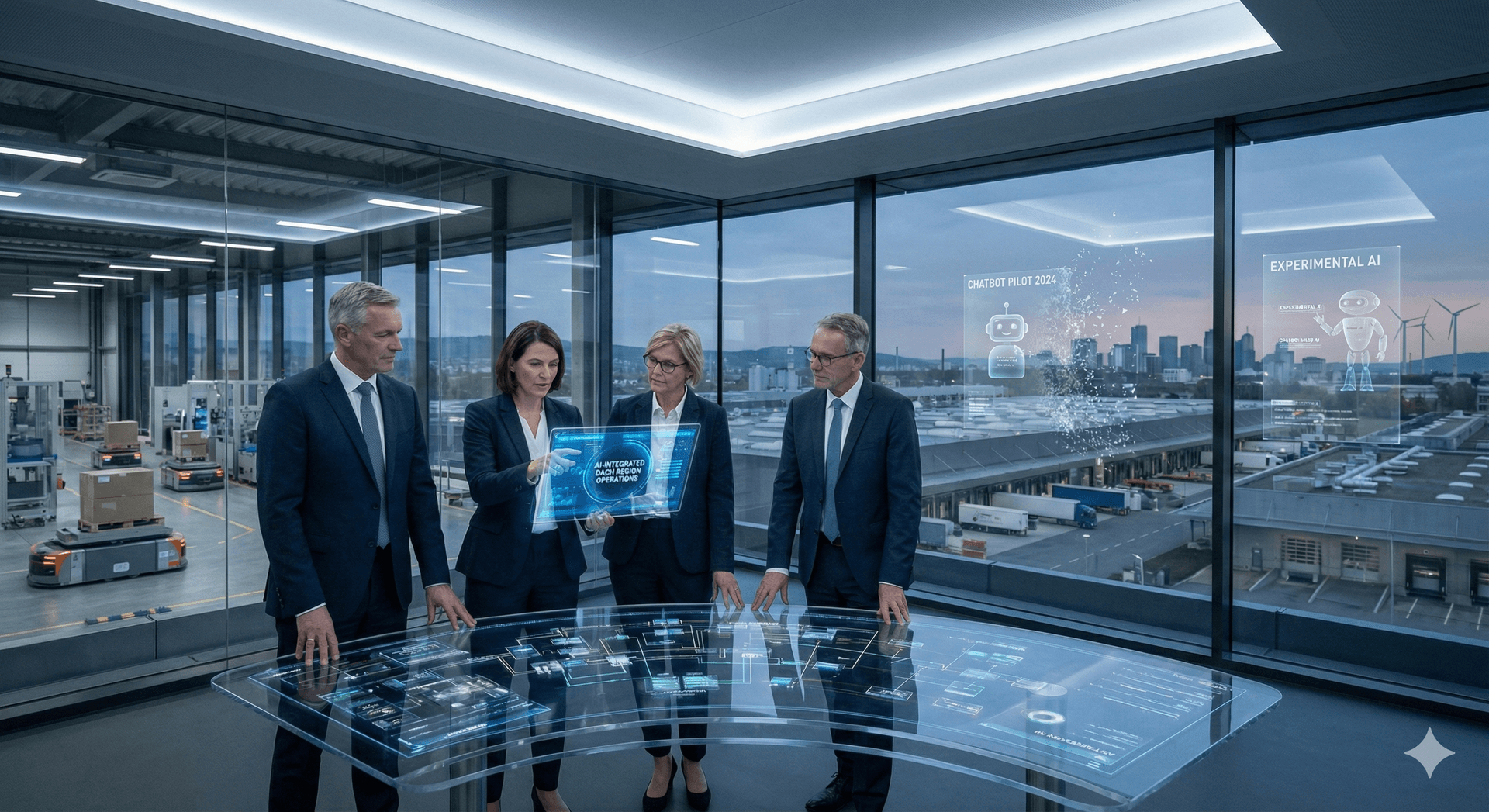
2024 marked the peak of generative experiments. For decision-makers in the DACH region, the focus now shifts fundamentally: Away from isolated chatbots, toward deep integration of AI into industrial and administrative value creation. Those who want to lead in the technological maturity of 2025 and 2026 must understand AI as a strategic operating system – not as an additive tool.

The past year will go down in business history as a phase of initial fascination. Generative AI flooded offices, sparked imagination, yet often remained stuck in isolated pilot project status.

The outlook for 2025 and 2026 reveals a turning point: The phase of mere enthusiasm gives way to strategic consolidation. Companies increasingly recognize that true competitive advantage lies not in content creation, but in the systemic integration of technology into core processes.
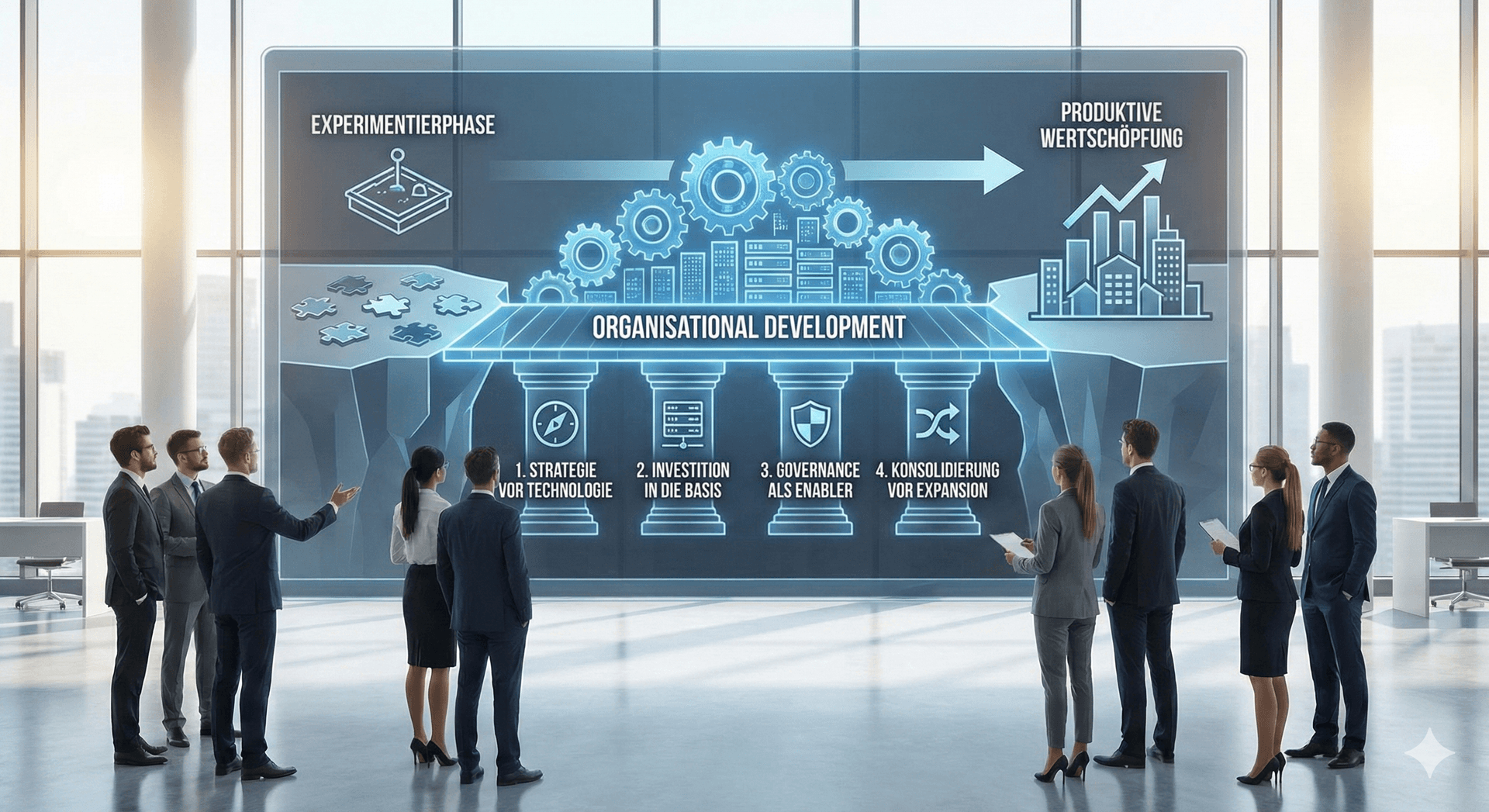

The Pragmatic Pivot: From Cost Cutter to Growth Driver

The four pillars of AI transformation

The four pillars of AI transformation in enterprises

The speed at which euphoria transforms into pragmatic daily business significantly exceeds previous technology cycles.

According to a Capgemini analysis, executives are already realigning their strategies for 2025. While operational efficiency and cost savings initially dominated the agenda, benchmarks are now shifting massively toward revenue growth, innovation, and customer experience.

Deepening the Technological Foundation

The realization is maturing that AI models without access to context-rich and structured enterprise data only deliver generic results. Consequently, organizations are investing massively in their data infrastructure.

A Deloitte study underscores: Leading companies prefer enterprise-wide implementations over isolated experiments. In doing so, the AI agenda moves directly to the CEO's domain.

Almost two-thirds of companies are reallocating capital from low-value projects to areas promising long-term value creation.

System Depth in Practice: Examples of Industrial Excellence

What successful integration beyond the marketing department looks like is demonstrated by pioneers from the DACH region.

Buhler Group (Switzerland)

The company uses AI to optimize its malting plants. Algorithms analyze raw material quality and weather data to control drying processes in real-time.

Result: 16 percent reduction in energy consumption

Georg Fischer AG (Switzerland)

In quality assurance, camera-based AI supports inspectors in analyzing weld seam scans.

Result: Significantly increased defect detection accuracy

SCHMOBI (Steel Service Provider)

The company automates its order processing through a solution that recognizes the structure and content of PDF orders and creates them directly in the ERP system. Automation rate: 70 percent for email order intake.

The insight: Successful integration happens where technology seamlessly merges with the existing system landscape.

Governance as Enabler: The Foundation for Scaling

The required system depth demands robust data governance. The trend is moving away from manual review processes toward automated governance functioning as an invisible safety net.

According to Atlan analyses, the role of the data catalog is shifting from mere documentation to an active context layer. Only when AI understands the semantics and context of data can it deliver reliable results.

Human-in-the-Loop concept

Human-in-the-Loop: Human and machine working together

Governance as Innovation Catalyst

This development is accelerated by the EU AI Act and growing awareness of "Trusted AI." Governance is no longer seen as a regulatory obstacle but as a catalyst for innovation.

  • More than half of companies prioritize data sovereignty (Capgemini)
  • Governance models must evolve from static oversight to continuous monitoring (PwC)

2026: The Rise of Agentic AI and Autonomous Workflows

For 2026, an even more radical shift is emerging: the rise of "Agentic AI." While today's systems primarily generate content, future AI agents will be capable of acting autonomously and orchestrating complex processes across system boundaries.

The Forecasts

  • Accenture predicts a "Binary Big Bang" where AI as an active development partner fundamentally transforms the IT system landscape
  • 77 percent of international executives expect AI agents to revolutionize their IT architecture

Hyperautomation and Democratization

These agents serve as the link between previously isolated applications. The trend toward hyperautomation optimizes entire workflows – from IT to customer service to HR.

Democratization will enable non-developers to configure agents in the future. This massively increases innovation speed in business units.

South Korea as global blueprint: Through the interplay of national strategy, language-specific models, and cultural acceptance, the country was able to massively scale its AI adoption in record time.

The Human Factor: Upskilling as ROI Turbo

Despite technological autonomy, humans remain the decisive factor. Integration success depends significantly on how well the workforce is prepared for collaboration with intelligent systems.

PwC AI Jobs Barometer 2025

Investments in AI competencies pay off directly economically: Workers with specialized AI know-how achieve wage premiums of up to 56 percent. The market values the ability to create value with AI extremely highly.

Human-in-the-Loop: Enablement Not Displacement

In specialized solutions, like those used in the hotel industry with Rocket 2.0, AI handles the groundwork while final decision authority remains with humans.

This approach increases efficiency and acceptance equally. Swiss executives view AI predominantly as a complement – the focus is clearly on increasing productivity and quality.

Conclusion: From Experiment to Business Excellence

For decision-makers, a clear action maxim emerges: The focus must shift from pure technology procurement to organizational integration.

Successful companies build architectures where data flows and agents can act. This requires investments in platforms rather than isolated point solutions.

As skill requirements in AI-exposed professions are changing 66 percent faster than in other areas, adaptability becomes the most important core competency.

Tomorrow's winners are defined by how effectively they merge technological excellence with human judgment and robust governance into a new form of business intelligence.

Related Articles

From Experiment to Strategic Integration?

In 1:1 AI Sparring, we develop your roadmap for AI that functions as the operating system of your value creation.

Book Free Consultation

No obligation. Personal. 30 minutes.